
The summer before Year 7 is supposed to be about ice creams, late nights, and celebrating the end of primary school.
But for many of our families in Halifax, that six-week holiday feels like a ticking clock.
If your child is neurodivergent, the "Big Move" to high school isn't just a change of buildings. It’s a complete shift in their universe. The corridors are louder, the faces are new, and the expectations are massive.
It’s completely normal if you’re feeling a knot in your stomach right now. You aren’t being "over-anxious" : you’re anticipating a huge transition for a child who thrives on the familiar.
One of the biggest hurdles we see during this time is something called EBSA.
What actually is EBSA?
EBSA stands for Emotionally Based School Avoidance.
In the past, people might have called it "school refusal" or "truancy," but those words are unhelpful. They suggest the child is being naughty or defiant.
EBSA is different. It’s an anxiety-driven inability to go to school.
For an autistic child or a child with ADHD, the school environment can sometimes feel physically painful or emotionally impossible. When they can’t face the gates, it’s because their nervous system is in "fight or flight" mode.
Recognising this is the first step. It isn’t about "won't": it’s about "can't."
Using the summer to prepare
We can't take away the transition, but we can make the new school feel a little less like an alien planet.
During the holidays, try focusing on "familiarisation" rather than "work."
- The Route: Walk or drive the new school route multiple times. Make it a casual trip to get a hot chocolate nearby so the journey doesn't always end at the school gates.
- The Uniform: Don't wait until September 1st to take the tags off. Let them wear the blazer or the new trousers around the house. Wash them a few times to get that "stiff" feeling out of the fabric.
- Visuals: Most schools have a website with staff photos. Print them out. Create a simple visual transition guide so they can see the faces they’ll be meeting.
Our My Transitions tool is a great place to start mapping these changes out together.
The 'Soft Start' strategy
You don't have to follow the standard "all-in" approach if you know your child will struggle.
Talk to the school's SENCO (Special Educational Needs Co-ordinator) now. Ask about a "soft start." This might look like:
- A shorter day for the first week.
- A "familiarisation tour" a day before the other students arrive.
- A designated "safe space" or SEN base they can go to the second they arrive, instead of waiting in a busy playground.
Schools have a duty to make reasonable adjustments. If your child needs a slower pace to feel safe, it’s okay to ask for it.
Build an Anxiety Toolkit
Having a "go-bag" of regulation tools can give a child a sense of agency when they feel overwhelmed in a big secondary school.
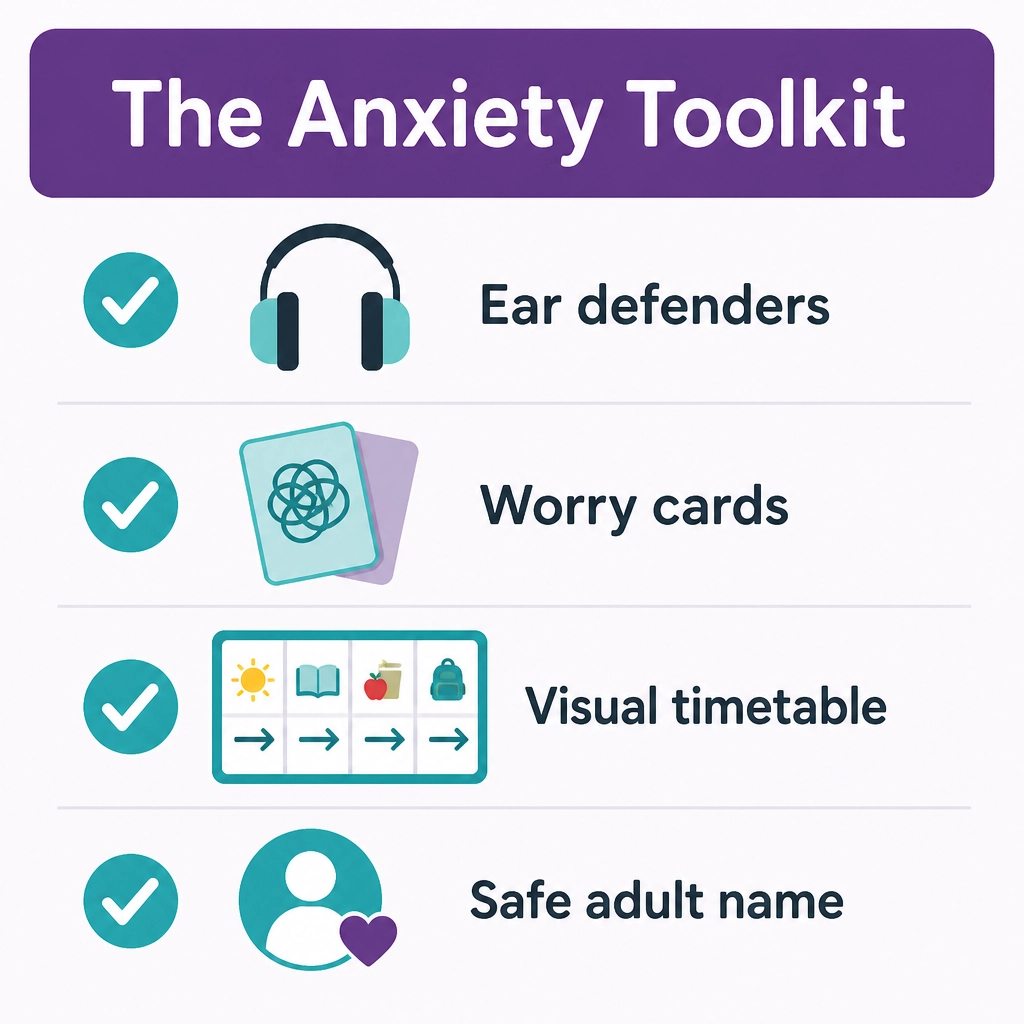
Here is a quick checklist for the school bag:
- Ear defenders or loops: Essential for those echoing high school corridors.
- Worry cards: Small cards they can hand to a teacher if they are too overwhelmed to speak.
- A "Safe Adult" name: One specific person they know they can go to if it all gets too much.
- Fidget tools: Something discreet they can use under the desk to help stay grounded.
You can use our Sensory Overload guide to help them identify what triggers them most.
When school refusal hits
Sometimes, despite all the prep, the first few weeks are still incredibly hard.
Watch for the early signs of EBSA. It might not be an outright "I'm not going." It often looks like:
- Physical symptoms (tummy aches, headaches) every morning.
- Total "shut down" or "meltdown" when they get home (the "coke bottle effect").
- Increasingly disrupted sleep on Sunday nights.
If this happens, the best thing you can do is communicate with the school early.
Don't wait for a fine or a formal meeting. Send an email to the SENCO and the Head of Year. Use the term EBSA and explain that your child is struggling with anxiety, not behaviour. You are a team, and the goal is to find a way to make the environment feel safe again.
We are right there with you
Navigating the high school move is exhausting for parents, too. You’re often the one holding all the anxiety while trying to put on a brave face.
At Noa's Place, we’re working hard to find our permanent home in Halifax: a space designed specifically for this kind of decompression. We want to build a hub where your teen can come after a tough school day to just be, without having to mask or perform.
Until that building is open, our online community and interactive tools are here to support you. Whether you need a safety plan for the tough mornings or just a place to feel understood, you aren't doing this alone.
Together we make space.