Have you ever walked into a supermarket and felt like the world was suddenly turned up to eleven? The fluorescent lights humming overhead, the rhythmic 'beep-beep' of the checkouts, the smell of the rotisserie chicken mixing with the floor cleaner, and a sea of people moving in every direction?
For most people, it’s a bit annoying. For many neurodivergent children and adults, it’s physically painful.
As we approach Global Accessibility Awareness Day (GAAD) on the 21st of May, we usually see a lot of talk about physical access. We talk about ramps, wider doorways, and lifts. And don’t get me wrong: those things are vital. At Noa’s Place, we believe everyone should be able to get through the front door.
But what happens once you’re inside?
If a building has a perfect ramp but is filled with flickering lights and echoing walls, it’s still inaccessible to a huge part of our community. That’s why we’re looking at accessibility through a different lens: sensory design.
The Invisible Barriers
When we think about disability, we often think about what we can see. A wheelchair, a white cane, a hearing aid. But many of the families we support at Noa’s Place deal with "invisible" barriers every single day.
Imagine your brain is like a cup. Every bit of sensory information: a loud noise, a scratchy clothing tag, a bright sunbeam: is a drop of water in that cup. For most people, the cup has a drain at the bottom. The information flows in and out. But for someone with sensory processing differences, that drain might be blocked. The drops keep adding up until the cup overflows. That’s when we see meltdowns, shutdowns, or extreme distress.
Designing for "low-sensory stress" is about making sure we don't fill that cup up the moment someone walks into a room.
Why Global Accessibility Awareness Day Matters to Us
Global Accessibility Awareness Day is all about getting people to talk, think, and learn about digital and physical access. It’s a day to remind the world that "normal" is a myth and that "standard" design often leaves people behind.
At Noa's Place, we’re currently an online-first community (we’re working hard on our CIO application for charity status!), but our dream is a physical hub in Calderdale. As we plan that space, GAAD reminds us that accessibility isn't a "nice-to-have" feature. It’s the foundation of everything we do.
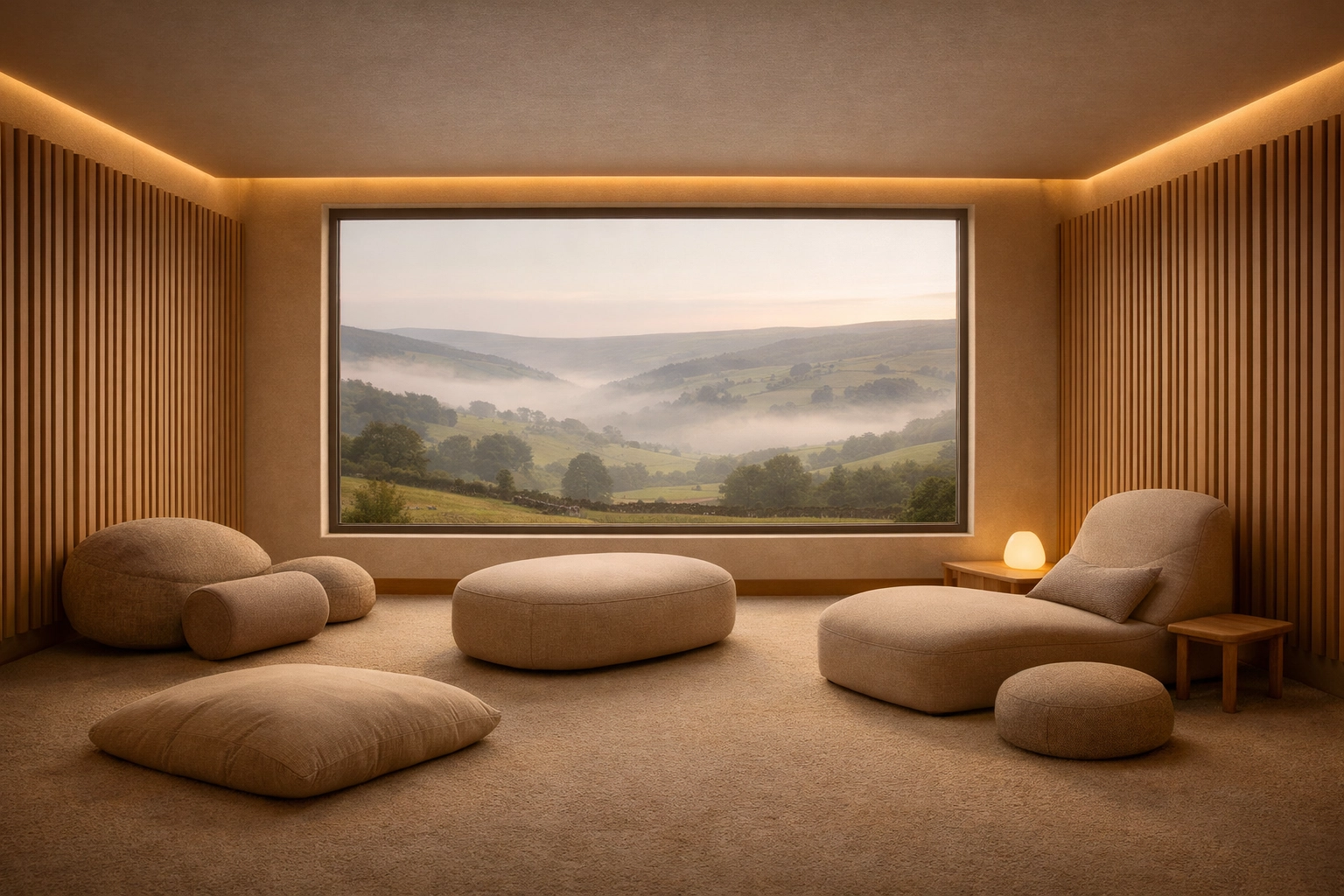
We want to move beyond the minimum requirements. We want to create a space that doesn't just "house" people but actually helps them feel regulated, safe, and calm.
Lighting: The Silent Trigger
If you’ve ever had a migraine, you know how much light can hurt. For many neurodivergent people, standard office or shop lighting is like a constant, high-pitched scream for their eyes.
Fluorescent tubes are the worst offenders. They often have a microscopic flicker that most people don't notice, but a sensitive nervous system can pick it up. It’s exhausting.
In our future hub, and in the advice we give to families now, we focus on:
- Dimmable lights: Being able to control the "volume" of the light is a game-changer.
- Warm tones: Avoiding that cold, blue-ish "hospital" light in favour of soft oranges and yellows.
- Indirect lighting: Using lamps or uplighting so the light bounces off the walls rather than beaming directly into someone's eyes.
If you’re struggling with sensory overwhelm at home, you might find our Sensory Overload tool helpful for identifying these triggers.
Acoustics: Turning Down the World
Have you ever tried to have a conversation in a room with high ceilings and hard floors? The sound bounces everywhere. For a child who struggles to filter noise, that echo makes it impossible to focus on what you’re saying. They aren’t "ignoring" you; they literally can't find your voice in the soup of noise.
Designing for low-sensory stress means thinking about "soft" architecture:
- Acoustic panels: These don't have to look like grey foam blocks. They can be beautiful fabric wall hangings or even special ceiling tiles.
- Soft furnishings: Carpets, rugs, and cushions aren't just for comfort: they are sound-munchers.
- Quiet zones: Having a dedicated space where there is no background music and no humming machinery.

Predictability: The Map of the Mind
Anxiety often comes from the unknown. For many neurodivergent kids, walking into a new building feels like walking into a maze where the walls might move at any second.
Predictable layouts are a form of accessibility. If a child knows exactly where the "calm zone" is, where the toilets are, and where the exit is, their stress levels drop instantly. We use clear signage, consistent colours for different areas, and open sightlines so there are no scary surprises around the corner.
We even encourage parents to use our Transition Plan tool to help prepare for moving between different environments or activities.
The Power of 'Listening'
One of our core values at Noa’s Place is Listening. We don’t pretend to have all the answers. We know that the real experts are the parents, the carers, and the neurodivergent individuals themselves.
Before we even drew the first sketch of what our Calderdale hub might look like, we started listening. We asked families: "What makes you leave a place early?" and "What makes your child feel safe?"
The feedback was eye-opening. Parents didn't ask for flashy gadgets or expensive tech. They asked for things like:
- "A place where my child can hide if it gets too much."
- "No hand dryers in the bathrooms: the noise is terrifying."
- "Adjustable chairs that let my child fidget without falling off."
These insights are shaping our journey. We aren't just building a centre; we are co-creating a sanctuary.
How You Can Start "Sensory Designing" Today
You don't need a degree in architecture to make a space more accessible. You can start in your own living room or your local community group.
Try a 10-minute sensory walkthrough. Stand in the middle of the room and ask yourself:
- Where are my eyes drawn? Is there a cluttered shelf or a bright light that feels "loud"?
- What can I hear if I’m silent? Is the fridge humming? Is there a clock ticking?
- How does the air feel? Is it stuffy or too cold?
Making three small shifts: like replacing a harsh bulb with a warm lamp, putting felt pads on the bottom of noisy chair legs, or clearing away visual clutter: can make a massive difference to someone’s ability to stay calm and engaged.
If you’re an adult looking to understand your own needs better, our Sensory Profile for Adults is a great place to start.
Building the First Hub of Its Kind in Calderdale
Our big goal is to bring all these principles to life in our first physical hub right here in Calderdale. It won't just be a building with a ramp; it will be a space designed from the ground up to respect the nervous system.
It’ll be a place where a child can be themselves without being "too much." A place where parents can breathe out, knowing the environment isn't working against them.
We are currently in the middle of our CIO application to become a registered charity, and every bit of support helps us move closer to opening those doors. We’re building more than just walls: we’re building a community that understands that accessibility means feeling welcome, not just being able to get inside.
Join Our Journey
We’d love for you to be part of what we’re doing. Whether you’re a parent looking for support, someone interested in inclusive design, or a local business wanting to be more sensory-friendly, there’s a place for you here.
- Follow our journey: Keep an eye on our About page for updates on our hub and our charity status.
- Explore our tools: From safety plans to coping with feelings, we have a range of free resources designed to help families navigate the world more easily.
- Get in touch: If you have ideas about sensory accessibility or want to share your experience, contact us. We are always listening.
This Global Accessibility Awareness Day, let's remember that a ramp is just the beginning. True accessibility is about creating a world where everyone's senses are respected, and no one has to leave because the "volume" of the world is too high.
Let's build that world together, one low-stress space at a time.