
Hello everyone, Josh here.
If you’ve been following our journey at Noa’s Place for a while, you’ll know that we’re deeply passionate about creating a world where sensory needs are understood, respected, and supported. Usually, when people think of "sensory rooms" or "inclusive play," their minds go straight to children. And while supporting our little ones is a huge part of what we do, it’s only one piece of the puzzle.
As we look ahead to Dementia Action Week (18-24 May), I wanted to take a moment to talk about the other end of the age spectrum.
Dementia is a journey that can feel incredibly isolating: not just for the person living with it, but for their families too. It’s a transition that requires an immense amount of empathy, patience, and, most importantly, the right environment.
At Noa’s Place, we believe that sensory support isn’t something you outgrow. Whether you’re five years old or eighty-five, your nervous system needs to feel safe to function well. Today, I want to explore why sensory spaces are a game-changer for dementia care and why we’re working so hard to bring a truly intergenerational hub to Halifax.
What is Dementia Action Week?
Dementia Action Week is a national event that encourages people to take action to improve the lives of those affected by dementia. In a dementia-friendly Halifax, this means more than just putting up a few signs. It means rethinking how we build our community spaces so that everyone, regardless of their cognitive health, feels welcome and capable.
For us, "action" means building a bridge between generations. It means creating a place where a toddler with autism and a grandfather with Alzheimer’s can both find a sense of peace in the same building.

The Science of "Decompressing"
When we talk about dementia, we often focus on memory loss. But for many families, the most challenging part is "agitation."
Imagine walking into a room where the lights are buzzing slightly too loud, the floor feels uneven, and you can’t quite remember why you’re there. Your brain starts to send out SOS signals. For someone with dementia, the world can often feel like it’s set to 150% volume. This leads to sensory overload, which often manifests as pacing, shouting, or deep distress.
This is where regulation comes in.
A sensory room isn't just a place with "cool lights." It is a controlled environment designed to dial down that external noise. By using soft, rhythmic lighting, gentle sounds, and weighted blankets, we can help a person’s nervous system move from a state of "fight or flight" back into "rest and digest."
In our vision for the physical Noa’s Place hub, our sensory rooms won’t just be for kids. They will be quiet sanctuaries for seniors to decompress when the world feels like it’s too much. It’s about giving people back their sense of control.
If you’re supporting a loved one at home right now, you might find our interactive sensory overload tool helpful to understand what they might be experiencing.
Recall: Sparking Memories Through the Senses
We’ve all had that moment where a specific smell: maybe fresh rain or a certain perfume: instantly transports us back to a childhood memory. This is the power of sensory recall.
In the later stages of dementia, verbal communication often fades. But the senses remain remarkably resilient. Research shows that multisensory environments can trigger "reminiscence."
- Touch: Feeling the texture of a piece of velvet or smooth wood can ground someone in the present moment.
- Scent: The smell of lavender or peppermint can evoke feelings of a garden or a kitchen from decades ago.
- Sound: A specific song can spark a smile or a story that hasn't been shared in years.
By providing these targeted sensory inputs, we aren't just "entertaining" someone; we are helping them find a pathway back to themselves, even if only for a few minutes. This is why sensory support for seniors is such a vital, medication-free way to improve quality of life.

A Place for All Ages: The Intergenerational Café
One of the things I am most excited about for our future hub in Halifax is our café.
Isolation is a huge issue for seniors with dementia and for parents of children with additional needs. Often, these two groups are kept separate. But why?
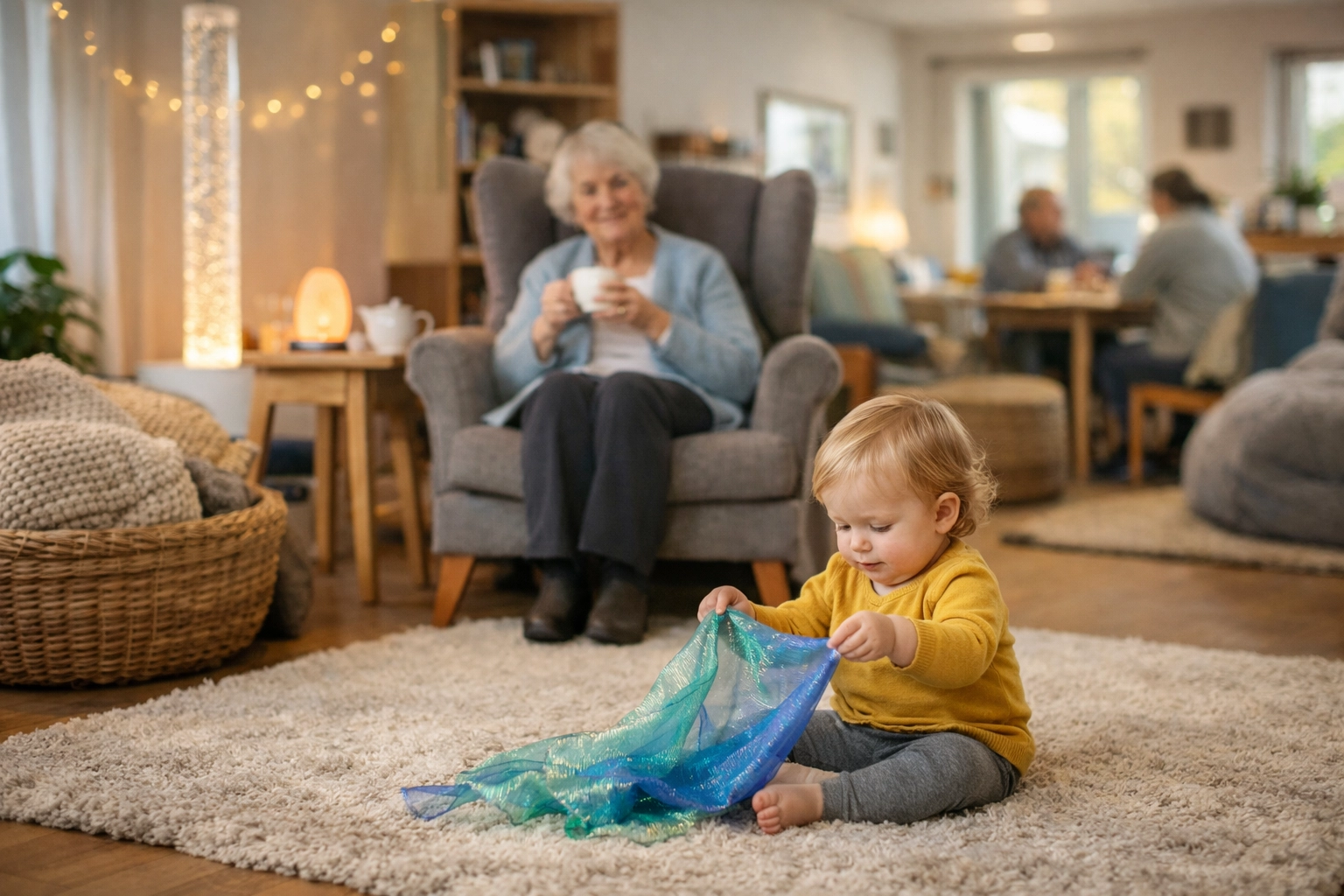
At Noa’s Place, we want to break those walls down. Imagine a café where the acoustics are designed to be soft, where the seating is comfortable for all bodies, and where there is zero judgement if a child has a meltdown or if a senior becomes confused.
We see our café as a place for intergenerational connection. There is something incredibly healing about the way children and seniors interact. Children often don't see the "disability" or the "illness": they just see a person. And for a person with dementia, being around the energy and joy of children can be the best kind of sensory stimulation.
How We’re Helping Right Now
While we are still in the process of securing our physical building and our CIO (Charity Incorporated Organisation) application is currently in progress, we aren't waiting to start helping.
Noa’s Place is currently an online community and resource hub. We’ve developed a suite of interactive tools designed to help families navigate these tricky transitions.
For those supporting an adult with dementia or other sensory needs, I highly recommend checking out our All About Me (Adult) tool. It’s a simple way to document what makes a person feel safe, what their triggers are, and what brings them joy. It’s a vital resource for carers and family members to ensure the person’s identity remains at the heart of their care.
You can also explore our Sensory Profile for Adults to get a better handle on how your loved one processes the world around them.

Why Halifax Needs This
Halifax is a wonderful community, but like many places, we have a gap in truly inclusive, multi-generational spaces. We want to help fill that gap. We want Noa’s Place to be a cornerstone of a dementia-friendly Halifax, providing a safe haven for every family in the Calderdale area.
We know that life transitions are hard. Whether it’s moving from childhood to adulthood or navigating the changes that come with aging, these shifts are scary. Our life transitions tool is built to help manage that anxiety, offering a roadmap through the fog.
Help Us Build a Space Where Every Age is Accepted
We are currently a community-led organisation with big dreams. We are working hard behind the scenes to move from an online presence to a physical reality. But we can’t do it alone.
This Dementia Action Week, we’re asking for your help. Whether it’s sharing our resources with a friend, following our journey on social media, or simply learning more about how sensory spaces can change lives: every bit of support counts.
We want to build a space where:
- A parent can bring their child for sensory play while their own parent enjoys a quiet, regulated space nearby.
- Agitation is met with empathy and a "safe room" rather than exclusion.
- Memories are cherished and encouraged through every sense.
Dementia doesn't define a person. Their needs, their history, and their right to feel safe define them.
Join the Conversation
If you’re caring for someone with dementia, or if you’ve seen the magic of sensory spaces firsthand, I’d love to hear from you. What would a truly inclusive space in Halifax look like to you? What tools do you need to make your day-to-day life a bit easier?
You can reach out to us via our contact page. We’re all in this together, and by sharing our stories, we can make sure that no one has to navigate the challenges of dementia or sensory processing alone.
Thank you for being part of our community. Let’s keep building a world where everyone has a place to belong.
Warmly,
Josh Barnes
Founder, Noa’s Place
Noa’s Place is a community-led organisation. Our application for charity status (CIO) is currently in progress. While our physical hub isn’t open yet, we are dedicated to supporting our community through online resources and advocacy.
To explore all of our free support tools, visit our Interactive Tools page.