
Meta description: Low demand parenting explained for neurodivergent families in West Yorkshire. Learn how reducing demands helps with PDA, meltdowns and burnout.
If you are reading this while hiding in the kitchen for five minutes of peace, or if you’ve spent the morning feeling like every word out of your mouth triggers a fresh explosion, you are not alone. Maybe you’ve just spent an hour trying to get your child to put on their socks, only for it to end in a flurry of tears, both theirs and yours.
The truth that many people don’t talk about is that parenting an autistic child is exhausting. It isn’t just the physical work; it’s the constant internal "risk assessment" you do every second of the day. You are constantly scanning the horizon for the next trigger, the next change in routine, or the next demand that might tip the balance.
We are right there with you. At Noa’s Place, we talk to families every week who are at breaking point because the "typical" parenting advice, the star charts, the firm boundaries, the "naughty steps", simply doesn't work for their children. In fact, for many neurodivergent children, that traditional advice actually makes things worse.
Why typical parenting advice often fails
If you’ve ever wondered "why does my child have meltdowns?" over things that seem tiny to everyone else, it isn’t because they are being difficult. It’s because their nervous system is responding to a perceived threat.
For many neurodivergent children, particularly those with a Pathological Demand Avoidance (PDA) profile, everyday requests feel like an attack on their autonomy and safety. PDA is a profile on the autism spectrum where the need to avoid demands is driven by extreme anxiety.
When you say "it’s time to brush your teeth," a neurotypical brain hears a task. A brain wired for PDA hears a loss of control, which triggers a "fight, flight, or freeze" response. This is why standard discipline fails; you cannot punish a child out of a panic attack.
What is low demand parenting?
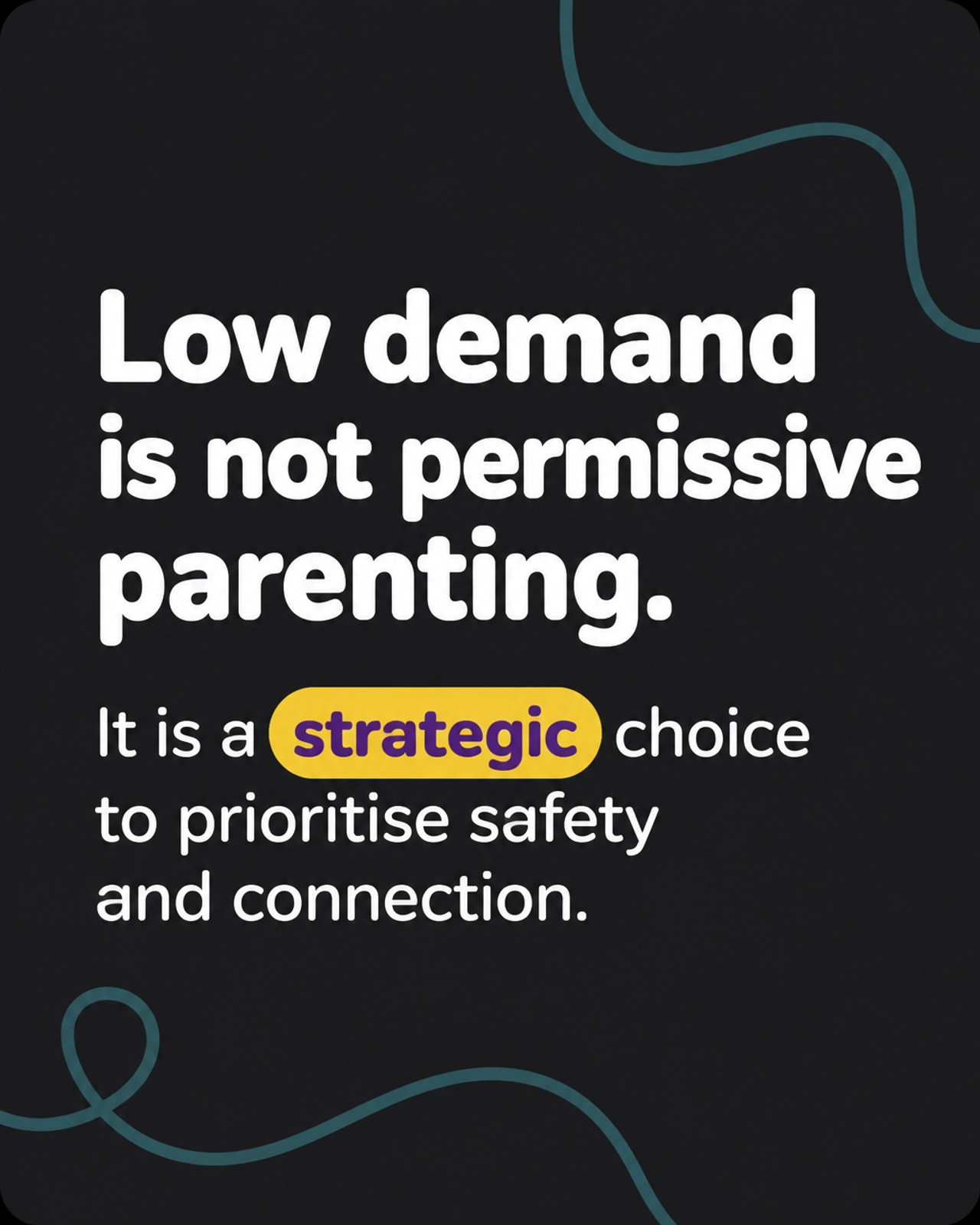
Low demand parenting is a strategic, intentional approach to caregiving that prioritises a child’s sense of safety and connection over their compliance.
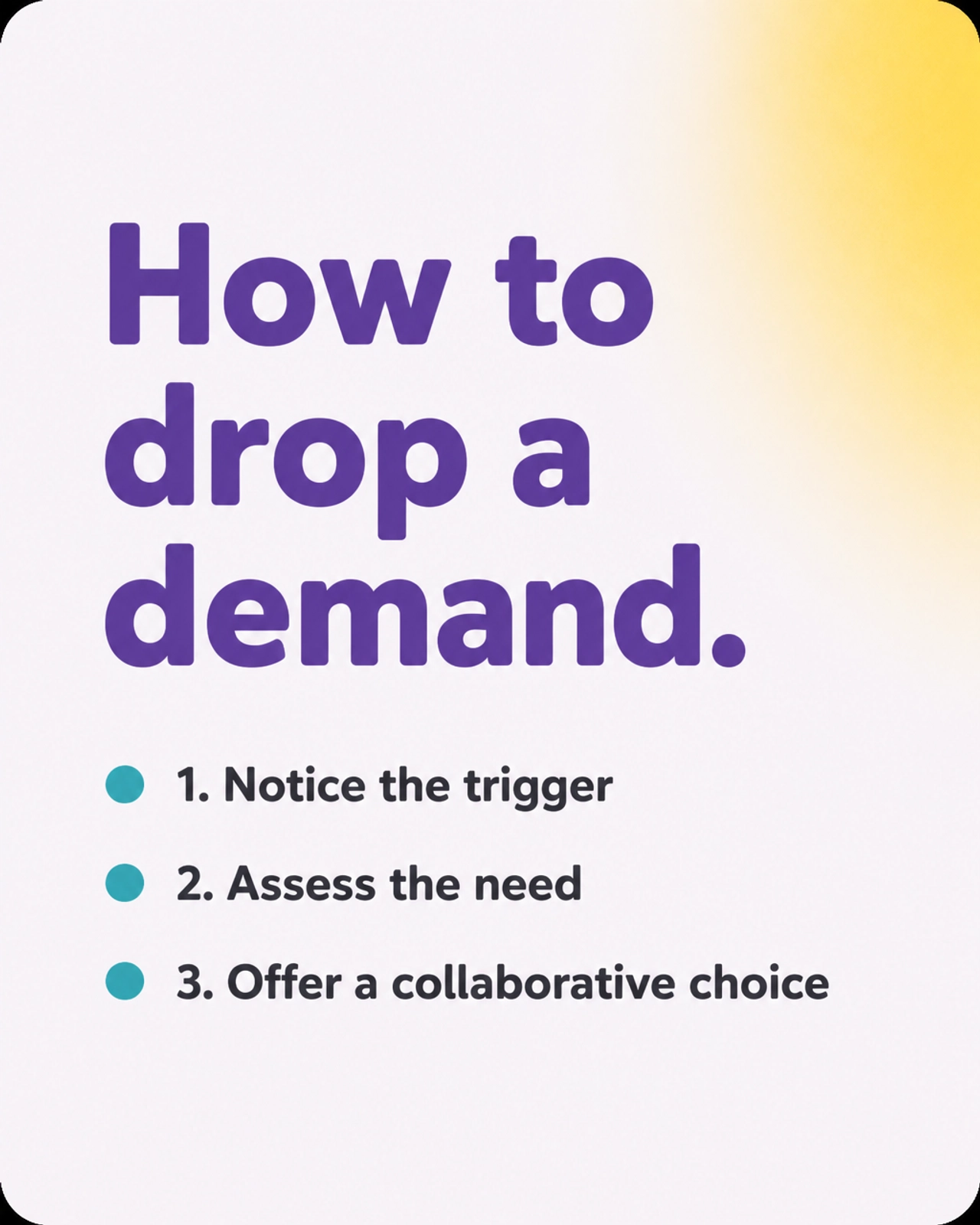
It involves looking at all the demands placed on a child in a single day, from getting dressed to eating certain foods, and deciding which ones are actually essential for safety and which ones can be "dropped" to lower the overall anxiety in the house.
It is often called a "low arousal" approach. By keeping the environment calm and the expectations flexible, you allow your child’s nervous system to move out of survival mode and back into a state where they can actually learn and connect with you.
Is it just "giving in"?
This is the biggest fear for many parents. It’s easy to worry that by dropping demands, you are being "permissive" or letting your child "get away with things."
But low demand parenting is not about neglect. It is about strategic demand reduction. You aren't ignoring your child's needs; you are acknowledging that their "bucket" is full. If their anxiety is at 90%, asking them to do something that takes 20% of their energy will result in a meltdown. By lowering the demands, you are keeping them within their window of tolerance.
Why it helps neurodivergent children
When we lower the demand, we lower the cortisol. Over time, this builds a deep sense of trust. Your child starts to learn that you are a safe harbour, not another source of stress.
For children seeking PDA support in the UK, this approach is often the missing piece of the puzzle. It allows them to feel in control of their own bodies and choices, which is the only way their anxiety can truly start to settle.
Practical steps: how to start dropping demands
Transitioning to a low demand lifestyle doesn't happen overnight. It is a practice of unlearning much of what society tells us about "good parenting." Here is how you can start this week:
1. The "Demand Audit"
Take a piece of paper and list everything you ask your child to do in a day. Now, categorise them:
- Non-negotiable: Safety (e.g., wearing a seatbelt, not running into the road).
- Important but flexible: Hygiene, eating (e.g., can they brush their teeth in the living room while watching TV? Can they eat a beige meal if it means they actually eat?).
- Socially expected but non-essential: Saying "please," making eye contact, sitting at the table, wearing specific "nice" clothes.
Start by completely dropping the "non-essential" category. You will be amazed at how much "breathing space" this creates for everyone.
2. Change your language
Direct commands like "Put your shoes on" often trigger an immediate "no" in a PDA brain. Try using declarative language instead. This means stating a fact or sharing a thought rather than giving an order.
- Instead of: "Go get your coat."
- Try: "I’m noticing it’s quite cold outside today; I’m going to grab my big jumper."
- Instead of: "Finish your homework."
- Try: "I wonder if we can find the red pen to finish this drawing."
3. Use collaborative problem solving
When a conflict arises, try to approach it as a team. Instead of "You need to tidy up," try "I’m worried someone might trip over these Lego bricks. Do you have any ideas on how we can make the floor safe?" This invites your child into the process rather than forcing them to submit to your will.
4. Prioritise sensory safety
Often, what looks like a refusal to follow a demand is actually a sensory issue. If your child won't put their shoes on, it might be that the seams in their socks feel like needles. Check out our guide on understanding sensory overload to help identify these hidden triggers.
Support in Calderdale and West Yorkshire
Living in Halifax or the surrounding areas of West Yorkshire, it can sometimes feel like you’re the only one doing things differently. When you’re at the Woolshops or trying to navigate a trip to the Piece Hall, the pressure to "make your child behave" can feel heavy.
We want you to know that the community in Calderdale is growing. At Noa's Place, we are building a permanent sensory-first community hub specifically because we know how much our families need a space where low demand is the norm, not the exception.
While we work on our permanent building, our community is very much active. We run sessions where your child can simply be themselves, without the pressure to perform or "fit in." You don't need a referral to join us; you just need to be you.
You can’t pour from an empty cup
If you are feeling the weight of parental burnout, please read our guide: You’re Not Failing: A Guide to Parental Burnout. Low demand parenting isn't just for the children: it’s a survival strategy for you, too. By reducing the battles at home, you are protecting your own mental health.
For more specific help with Pathological Demand Avoidance, you can explore our PDA Support Guide for UK Families.
Together we make space
Low demand parenting isn't about giving up; it’s about leaning in. It’s about choosing connection over control and peace over perfection. It’s hard work, and some days will still feel impossible, but every time you choose to validate your child's distress instead of punishing it, you are building a bridge.
At Noa’s Place, we believe that every family deserves to shine, exactly as they are. No masks, no pressure: just belonging.
Together we make space.
[Sonny Handoff Brief]
- Key Message: Low demand parenting is a strategic, compassionate choice for neurodivergent families, not "permissive" parenting.
- Target Audience: Burned-out SEND parents in West Yorkshire/Calderdale.
- Primary Message: You are not failing; typical advice just doesn't fit your child's nervous system.
- Social Formats:
- Instagram Carousel: "3 signs your child needs a low demand approach" + Language swap examples.
- Facebook Post: Honest reflection on the "exhaustion" of SEND parenting and an invitation to the Calderdale community.
- Quotes: "You cannot punish a child out of a panic attack." / "Low demand isn't no demand. It's intentional demand."
- Caption Hook: "If typical parenting advice makes your child's meltdowns worse... it's time for a different way."