
It starts with a stomach ache, a late night or a quiet, heavy “I can’t go”. If you are searching for what is EBSA, this guide explains emotionally based school avoidance in plain English and shares practical steps for supporting your child.
Mornings can become full of tears, shutdowns and panic. You may be trying to get everyone dressed while also answering calls from school and wondering what will happen next. This is exhausting and frightening.
Your child may look fine to other people. At home, you may see the full weight of what school is costing them. Understanding the reason underneath the absence is an important first step.
In a hurry?
- EBSA means Emotionally Based School Avoidance.
- It describes difficulty attending school because of anxiety, distress or unmet needs.
- It is not the same as truancy or deliberate defiance.
- Autistic and neurodivergent children may face extra sensory, social and academic pressure at school.
- Start with safety, listening and a meeting with the school’s SENCO.
- Ask for a support plan, reasonable adjustments and a clear review date.
- Keep a simple diary of patterns, triggers and what helps.
- If school support is not enough, consider requesting an Education, Health and Care needs assessment.
1. What is EBSA?
Emotionally Based School Avoidance is a term used when a child or young person finds attending school very difficult because of strong emotions, often anxiety or fear.
Some people still use the phrase “school refusal”. However, it can sound as though the child is simply choosing not to attend. EBSA puts the focus on the distress underneath the absence.
A child may want to go to school. They may understand that education matters. Their nervous system may still be telling them that school is too difficult or unsafe to manage.
EBSA is not truancy
Truancy usually means a child is away from school without their parent or carer knowing. EBSA is different.
With EBSA, parents are often aware of the absence. They may be trying everything they can to help their child attend. The child may be at home feeling worried, exhausted or physically unwell.
EBSA is also not the same as defiance. A child who cannot get through the school gates may be responding to overload, anxiety, social fear, bullying, unmet learning needs or a combination of pressures.
“Won’t” versus “can’t”
“Won’t go” describes what the situation looks like from the outside.
“Can’t go” asks what is stopping the child from managing school.
This does not mean every situation has one simple cause. A child may say no to school because they feel powerless, frightened or overwhelmed. Their words and actions are still giving you useful information.
The most helpful question is often:
What is making school feel impossible right now?
2. What signs should you look for?
EBSA can build slowly. Some children show clear distress. Others hide it at school and release it later at home.
Look for patterns rather than one difficult morning.
Physical signs
Your child may have:
- Tummy aches, headaches or feeling sick before school.
- Trouble sleeping on Sunday nights.
- Frequent requests to stay home.
- Regular visits to the school nurse.
- Changes in eating, toileting or energy.
- Panic, shaking or a fast heartbeat.
- Extreme tiredness after school.
Physical symptoms are real, even when anxiety is part of the picture. Speak to your GP if symptoms are new, severe or ongoing. This can help rule out physical causes and make sure your child receives the right support.
Signs at home
You may notice:
- Dread beginning the night before school.
- A meltdown when it is time to get dressed.
- A shutdown when you mention the school run.
- Refusal to leave the house or car.
- Needing much more help with everyday tasks.
- Extreme distress about uniform, food or the journey.
- A big release of emotion after school.
- Long periods of silence, sleep or withdrawal.
A shutdown is a response to overwhelming demands where a person may become very quiet, still or unable to communicate. It is not the same as being rude or ignoring you.
Signs at school
School may report:
- Lateness or repeated absence.
- Distress at the school gates.
- Avoiding particular lessons, places or people.
- Spending a lot of time in the toilet, medical room or another quiet space.
- A sudden drop in work or participation.
- Increased perfectionism or fear of mistakes.
- Difficulty moving between lessons.
- Loss of speech or communication when anxious.
- Becoming upset during lunch, assemblies or busy unstructured times.
Ask whether the pattern is linked to a particular day, subject, member of staff, peer group, room or transition. The detail can point towards useful adjustments.
3. Why can school feel so hard for autistic and neurodivergent children?
There is rarely one single reason. EBSA often develops when several pressures build without enough recovery time or support.
Sensory overload
Sensory overload happens when the brain receives more sound, light, touch, movement or smells than it can process comfortably.
School can include bells, echoing corridors, crowded classrooms, fluorescent lighting, strong smells and constant background noise. A child who manages these things for a while may still be using a great deal of energy to cope.
Helpful adjustments might include ear defenders, a quieter arrival, reduced visual clutter, access to a calm space or permission to leave a busy area before reaching crisis point.
Social demands
Children may worry about group work, break times, friendships, eye contact or being misunderstood.
They may also be dealing with bullying, isolation or unclear social rules. For some children, the social part of school is harder than the lessons.
A named trusted adult and a clear plan for unstructured times can make school feel more predictable.
Masking fatigue
Masking means hiding or changing natural ways of communicating, moving or responding in order to fit expectations or avoid standing out.
Masking is a personal coping strategy. Some autistic people use it in some situations, while others do not. It can take a lot of energy.
A child who holds everything together at school may have very little energy left by the time they get home. This can look like a sudden meltdown, shutdown or loss of everyday skills.
Academic pressure
Reading, writing, homework, tests and time limits may all create stress.
A child may understand the work but struggle to start, organise or complete it. Executive function means the mental skills used for planning, starting, switching and finishing tasks.
If the work feels impossible, the child may avoid the whole school day rather than one lesson.
Transitions and change
Transitions are changes between activities, rooms, adults or routines.
Moving from primary to secondary school can mean a larger building, more teachers, different rules and less time to recover. Smaller changes can also matter, such as a supply teacher, a changed timetable or a different journey.
Visual plans, advance warning and a familiar adult can reduce uncertainty.
4. What should you do first?
You do not need to solve everything in one day. Start with a calm, support-first response.
A five-step parent response plan
1. Listen before trying to fix it
Choose a calm time. Avoid asking questions during a meltdown or shutdown.
Try simple phrases such as:
- “What part of the day feels hardest?”
- “Is it the journey, the classroom, the people or the work?”
- “Would it be easier to tell me, write it down or show me?”
Your child may not know the answer straight away. Give them time.
2. Contact the SENCO
The SENCO is the Special Educational Needs Co-ordinator in a school.
Ask for a meeting with the SENCO, class teacher or head of year. Explain what you are seeing at home and ask what school notices during the day.
Use the term EBSA if it reflects your child’s experience. You can say:
“We are concerned that anxiety and unmet needs are affecting attendance. We would like to discuss an EBSA support plan.”
3. Ask for support, not punishment
Attendance matters, but pressure and punishment do not address the reason your child is struggling.
Ask for a plan that identifies:
- The likely causes of distress.
- The adjustments school will make.
- Who your child can go to.
- Where they can go if overwhelmed.
- How staff will respond to absence.
- How home and school will communicate.
- When the plan will be reviewed.
Put the agreed plan in writing. Clear notes can prevent misunderstandings later.
4. Discuss a soft start or reduced timetable
A soft start might mean arriving before the corridors become busy, entering through a quieter route or meeting a trusted adult at the gate.
A reduced timetable may also be considered when full-time attendance is not currently manageable. If this is suggested, ask for it to be:
- Written down.
- Time-limited.
- Based on your child’s needs.
- Reviewed regularly.
- Linked to a plan for increasing access when appropriate.
A reduced timetable should not become an informal way of excluding your child from education. Ask what learning and support will continue outside the hours they attend.
5. Keep a simple diary
Write down:
- Date and attendance.
- Sleep, food and physical symptoms.
- What happened before the distress.
- The lesson, place or transition involved.
- What your child said or communicated.
- What helped.
- Emails, meetings and agreed actions.
You do not need a perfect record. A few clear details can show patterns that are easy to miss during a stressful week.
For more ideas around school transitions, read How to Master the High School Move and Beat EBSA: A Guide for SEND Families.
5. What if school support is not enough?
Schools should make reasonable adjustments and provide support for special educational needs. Sometimes, however, a child needs more help than the school can provide from its usual resources.
You can ask your local authority for an Education, Health and Care needs assessment. This looks at your child’s education, health and care needs. If the local authority agrees that an EHCP is needed, the final plan sets out the support that must be provided.
You can make the request as a parent or carer. A school can also request one.
Evidence may include:
- Attendance records.
- Your EBSA diary.
- School reports.
- Information about meltdowns or shutdowns.
- Reports from health professionals.
- Your child’s views.
- Details of adjustments already tried.
- Clear information about what happens when support is not in place.
Read The Ultimate Guide to EHCPs: Everything You Need to Succeed in Getting SEND Support for a fuller explanation.
This guide is general information, not legal advice. Calderdale SENDIASS can offer free, impartial information about your options.
6. Build your EBSA toolkit
A toolkit does not need to be expensive. It is a set of information, questions and supports that helps your family understand patterns and ask for useful changes.
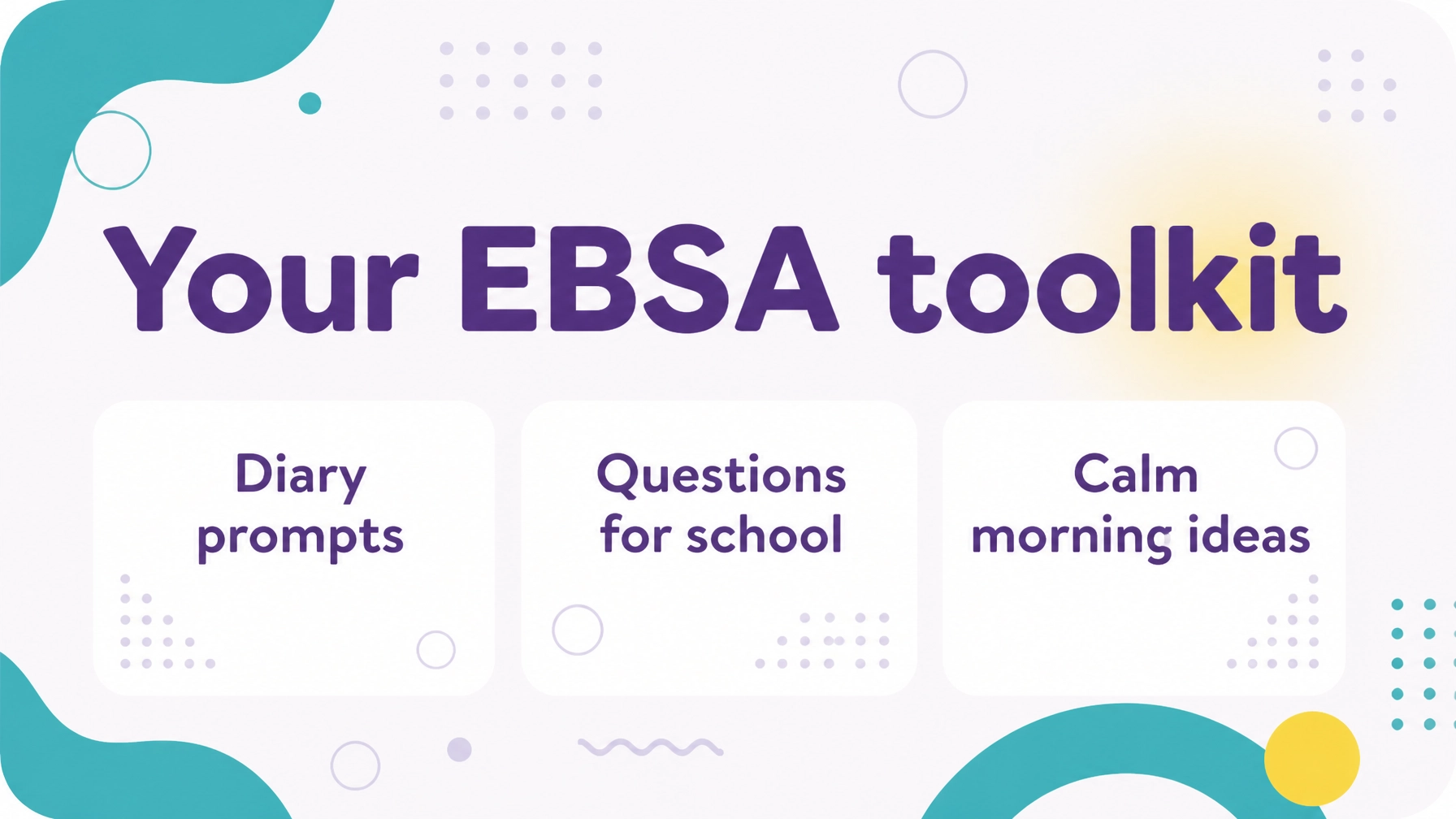
Printable diary prompts
Copy these into a notebook or print them out:
- What time did worry begin?
- What did my child say, do or show?
- What happened just before this?
- Was there a change, demand, noise or social situation?
- How was sleep the night before?
- What helped reduce distress?
- What made it harder?
- What should we ask school about?
Questions to ask the school
- Which parts of the school day are hardest?
- Is there a pattern by lesson, day or location?
- Who is my child’s trusted adult?
- Where can they go when overwhelmed?
- Can arrival, lunch or transitions be made quieter?
- Can instructions be written, visual or broken into smaller steps?
- How will staff respond to a shutdown?
- How will school contact us about concerns?
- When will we review the plan?
Calm morning routine ideas
- Prepare clothes, food and school items the night before.
- Keep the morning language short and calm.
- Use a visual checklist with only the essential steps.
- Build in extra time for dressing and travel.
- Offer two realistic choices where this helps your child.
- Reduce background noise and bright lighting.
- Agree what happens if the morning becomes too difficult.
- Keep a familiar comfort or regulation item available.
Regulation strategies
Regulation means helping the body move towards a more settled state. Different children need different things.
You could try:
- A quiet room with fewer words.
- Ear defenders or headphones.
- Movement before leaving home.
- Wall pushes, carrying a bag or another form of heavy work.
- A familiar fidget.
- A drink and a simple snack.
- Deep pressure only if your child likes and chooses it.
- A written card they can show when speech is difficult.
- A planned safe adult and calm space at school.
During a meltdown, focus on safety and recovery. Do not expect problem-solving while your child is overwhelmed.
Our guide, Autistic Meltdowns: What They Mean and How to Help, explains how to respond when distress reaches that point.
7. Calderdale and West Yorkshire support
If you live in Halifax, Sowerby Bridge, Todmorden, Brighouse, Hebden Bridge or elsewhere in West Yorkshire, the Calderdale SEND Local Offer is a useful place to look for local education, health, care, activities and events for children and young people with SEND.
Calderdale SENDIASS offers free, confidential and impartial information and advice. You can contact the team on 07771 977384 or 01422 266141, or email info@calderdalesendiass.org.uk.
The Jam Packed Summer 2026 scheme was a positive example of the kind of holiday provision Calderdale offers for disabled young people aged 8–19 at Ravenscliffe High School. The 2026 sessions ran from 20 July to 14 August, and applications for this year’s sessions closed on 12 June 2026. For future dates and applications, keep an eye on the Calderdale SEND Local Offer.
At Noa’s Place, our community is very much active while we build a permanent sensory-first community hub in Halifax. Sessions are running while we build. You can find current information about our community sessions and use our free interactive tools at home.
The permanent hub is a goal for the future. Until then, we are continuing to create calm, understanding support for families across Calderdale.
8. You deserve support that looks beneath the absence
EBSA can make every school morning feel like a crisis. It can affect sleep, work, family life and your child’s sense of belonging.
Your child’s absence is information. It tells you that something needs attention. The next step is not about blame. It is about understanding what school currently demands and what would make access safer and more manageable.
Start with one conversation. Keep one week of notes. Ask for one clear adjustment. Small steps can help you and school see the bigger picture.
Sign up for Noa’s Place updates to receive new guides, local information and community news. You can also explore our related resources on sensory overload and co-regulation.
Save this guide for a difficult morning and share it with another parent or a member of your child’s school team.
Together we make space.